
•home
Photo Files
(Click for high-res
JPG images)
 |
 |

PRESS RELEASE
Contact: Clyne Media, Inc.
Tel: (615) 662-1616
FOR IMMEDIATE RELEASE
Alt-Rock icons Garbage and FOH engineer David Gaumé tour with Waves LV1 Classic
— After years of building his live mixes around Waves processing, Gaumé moves to LV1 Classic, bringing the tools he already relied on into one seamless, integrated mixing workflow. —
Knoxville, TN, September 14, 2026 — Across Garbage’s 2026 European tour, FOH engineer David Gaumé took the band from theaters and clubs to festivals, city squares and outdoor stages — from Cardiff and Edinburgh Castles to London’s iconic Roundhouse — all on his own compact Waves LV1 Classic rig. For Gaumé, who had already built much of his live mixing around Waves, moving to LV1 brought a familiar workflow directly into the console, with everything in one integrated environment. “The LV1 to me is my playland,” he says. “That’s it.”
Bringing the whole mix workflow together
Gaumé has been Garbage’s front-of-house engineer since 2017. Long before he ever touched an LV1, he was already a heavy Waves user, in the studio and live. “I pretty much switched over a few years ago to all of my DSP pretty much happening in Waves,” he says. “I kind of focused my tool set on Waves, because it made sense to consolidate my workflow under one brand that met all my criteria, instead of chasing multiple third-party products.”That habit eventually turned his console into something he describes almost apologetically: a pass-through. “It got to where I was pretty much just pushing faders and flat channels on the desk, and everything was happening on this screen on the side,” he says. “I have this other system that I maintain along with my main system. It was kind of this appendage.”
Trying LV1 made him realize that the workflow he’d built around an external system could instead live directly inside the console. “I kind of realized it was the exact same thing I was doing, but it was all right here in front of me,” he says. His old workflow, by contrast, was scattered: “select channel, go to the plugin page, then it pops up over here, and then I’m doing something else over here.” With LV1, he says, “all the familiar tools are right in front of me, and I can pretty much manipulate sound any way I can imagine with this set of tools that are all running inside the LV1.”
Built to travel
For Garbage, another major draw is portability. “Garbage really thrives on being able to keep things compact and repeatable,” Gaumé says. “If I can make something small, and it’s affordable enough that I can purchase the thing and take it around the world with me, then I have a lot less situations where I’m walking up to a gig and saying, ‘I sure hope everything I advanced actually shows up.’”That same approach extends to Gaumé’s even more compact B-rig, an LV1 modular system designed to leapfrog ahead for fly dates and other situations where traveling light is essential. Despite its smaller footprint, the system gives him the same mix, DSP power and show file, allowing him to move between rigs without changing the workflow or sound he has built for Garbage.
That flexibility has mattered most on a tour that keeps landing in quiet rooms. “So many venues are moving into city parks and things, and getting quieter and quieter,” he says. Facing SPL limits as tight as 93 dBA or 100 dBC on a given night, he leans on Waves C6 and F6 to reclaim headroom without losing the show. “You have different tricks and tools, but C6 and F6 are instrumental in being able to claim back a dB here or there and make something still sound like a rock show” under those limits.
Inside the mix: Shirley Manson’s vocal
Asked what carries the show, Gaumé doesn’t hesitate. “Shirley’s vocal is the whole show. It is the make or break of everything,” he says. “I’ve got a great source, her voice. Her mic technique is wonderful, so I think the first rule of all that to me is do no harm. I’m not processing the vocal super heavily. You might see a lot of plugins in this chain, but they’re all just doing a little job here.”That restraint comes from a chain built in small, careful layers rather than one heavy-handed fix. The signal first passes through the Waves Primary Source Expander, to clean it up before it gets loud, with speed and threshold settings that Gaumé changes song to song as part of his LV1 automation. From there, the vocal hits an external Neve mic pre, “used mostly for silk,” followed by a Distressor (another external insert via the LV1) at 4:1 with a slow response. “That’s probably doing the heavy lifting as far as holding the vocal right there on top of the mix,” he says. From there David goes back to the Waves plugin chain, with de-essing around 7 kHz and the CLA-76 used partly in parallel, with its amount also changing by song.
Much of the remaining work is about precise dynamic control. Gaumé uses F6 alongside another de-esser around 3.5 kHz and a second F6 to detail the vocal without simply EQing frequencies away. A low-mid bump, for example, is dynamically compressed when Manson sings lower but allowed to open up as she moves higher, preserving the thickness of her voice. Other dynamic moves around 2.5–3 kHz and a high shelf around 6 kHz are there, he says, to “keep the air, keep the intelligibility” while controlling those frequencies only when needed.
On the vocal bus, a micro-delay provides subtle timing separation, a CLA-2A “just kisses every once in a while,” and Vitamin adds sweetness and air, with Gaumé riding its low-mid control as needed. There’s yet another de-esser — the third in the chain — followed by an L2 to catch the biggest peaks and an F6 kept at the end for anything he needs to address quickly during the show. “Rather than a few things doing something heavy-handed, each one has its own little purposeful thing it’s going after,” he says.
Finally, Gaumé runs a parallel vocal bus devoted almost entirely to air: lows shelved away, heavy limiting, repeated high-frequency boosts and aggressive de-essing leave him with a dedicated fader of ultra-high-frequency presence that he can ride into the mix at will. “It’s all just these layers of preserving what I can of high frequencies without harshness,” he says. “That’s the stuff that I think really makes her vocal shine.”
A workflow he didn’t expect to lean on
One LV1 feature caught Gaumé off guard: any plugin capable of sidechaining can trigger off any other, and that routing can change from song to song as part of his automation. He uses eMo D5 to let the bass guitar and kick drum trade space, pulling one back so the other’s low end can punch through, then reversing the relationship on the next song as his stage patches shift. “I’m pretty fearless about automating those relationships,” he says. “All of my instrument sources are direct — there are no mics — so while the patches, including the drum sounds, can change from song to song, the sources themselves are completely consistent. That consistency lets me approach the mix with much more of a studio mindset and really get after those details.”For tone, he leans on a consistent set of plugins across nearly every channel: F6, eMo D5 (the dynamics tool that’s part of the LV1 channel strip), and CLA-76, alongside dedicated coloration tools including the SSL EV2 strip, Magma BB Tubes and Magma Channel Strip. On drums, J37 tape saturation pushes the kit forward or back in the mix without changing its level, and an outboard API 2500 and Kush Clariphonic EQ, via external insert, on the mix bus stay under his hand for the whole show.
Trust, night after night
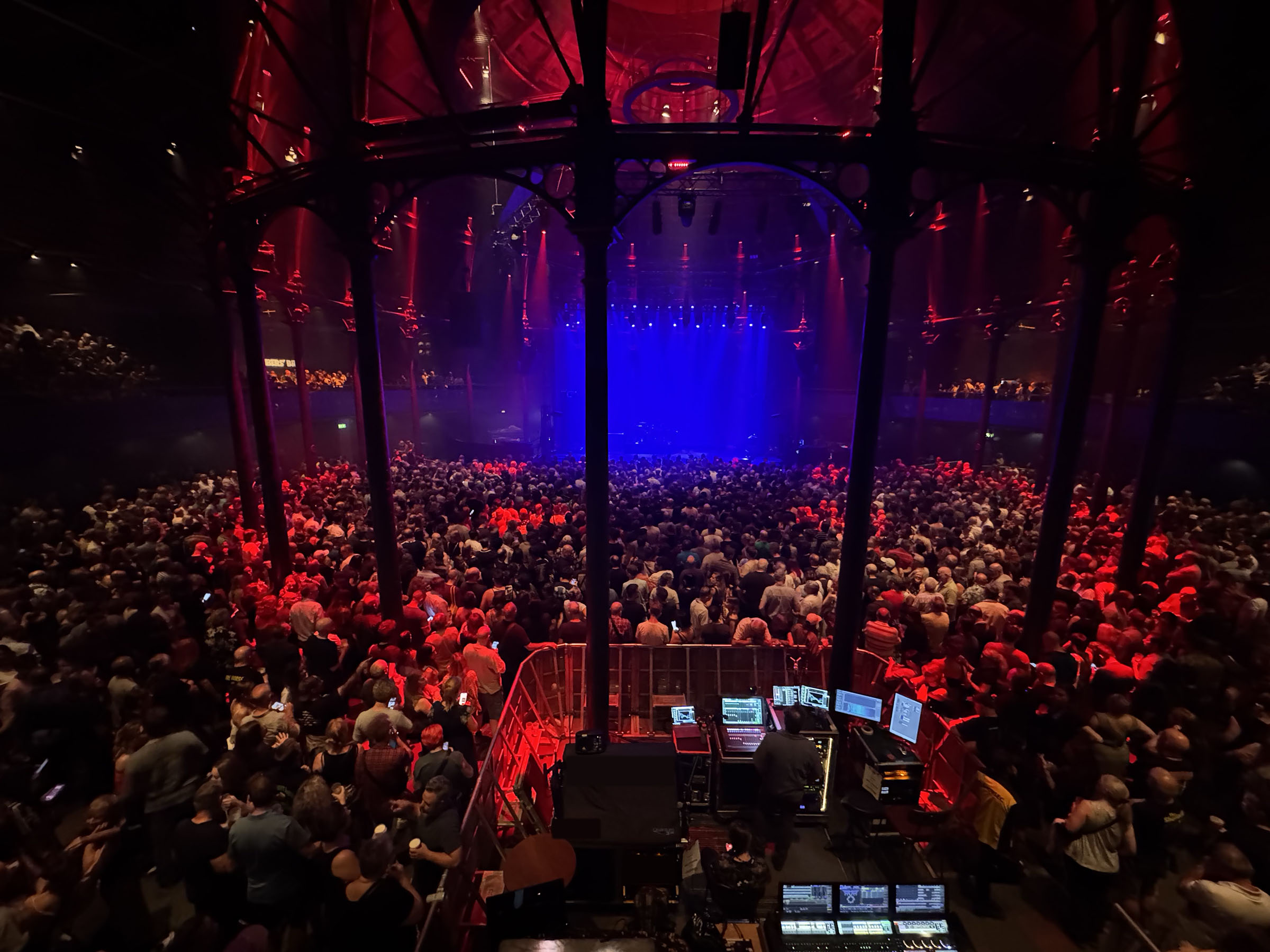
Ask Gaumé what he’d tell an engineer on the fence about switching, and he goes straight to the question he says everyone asks him. “Is it stable, and do you trust it? That is absolutely yes. I’ve never had any issue with it whatsoever. It’s been totally reliable for me, and that’s the most important thing.”That reliability also lets him keep the challenges of each venue separate from the mix itself. He names the Roundhouse — a perfectly round room with heavy floor reflections — as one of the toughest rooms on the tour. “I do all of my system tuning, and I try to get an even response out of the system. Once that’s all out of the way, then I’m just performing the same show as I did last night,” he says.
“I can focus on being a system tech during the day, and when it’s time to mix, it’s all right here. I plug it in, I turn it on, run a couple of songs from last night’s multitrack in virtual soundcheck. By the time the band is on stage, the real sound check is almost a formality, at least for FOH. The system and mix are already dialed. It’s a very repeatable workflow that yields consistent, predictable results.”
And once he’s there, LV1 gives him plenty of room to go as deep as he wants. “It’s a totally open playland of processing, and you can do whatever you want with sound,” he says. “On a long tour, it’s possible to get bored, and you just want things to play with, and you never run out of things to play with here... it’s a candy store.”
David Gaumé’s top 5 Waves plugins for live sound
- F6 — “My desert island plugin.”
- SSL EV2 Strip — “Beautiful color, beautiful character.”
- Magma BB Tubes / Magma Channel Strip — his go-to tube-driven tone shapers.
- CLA-76 — “Kicks ass, as you would expect any 1176.”
- eMo D5 — “The stock strip for the LV1... it’s just got everything.”
...ends 1449 words
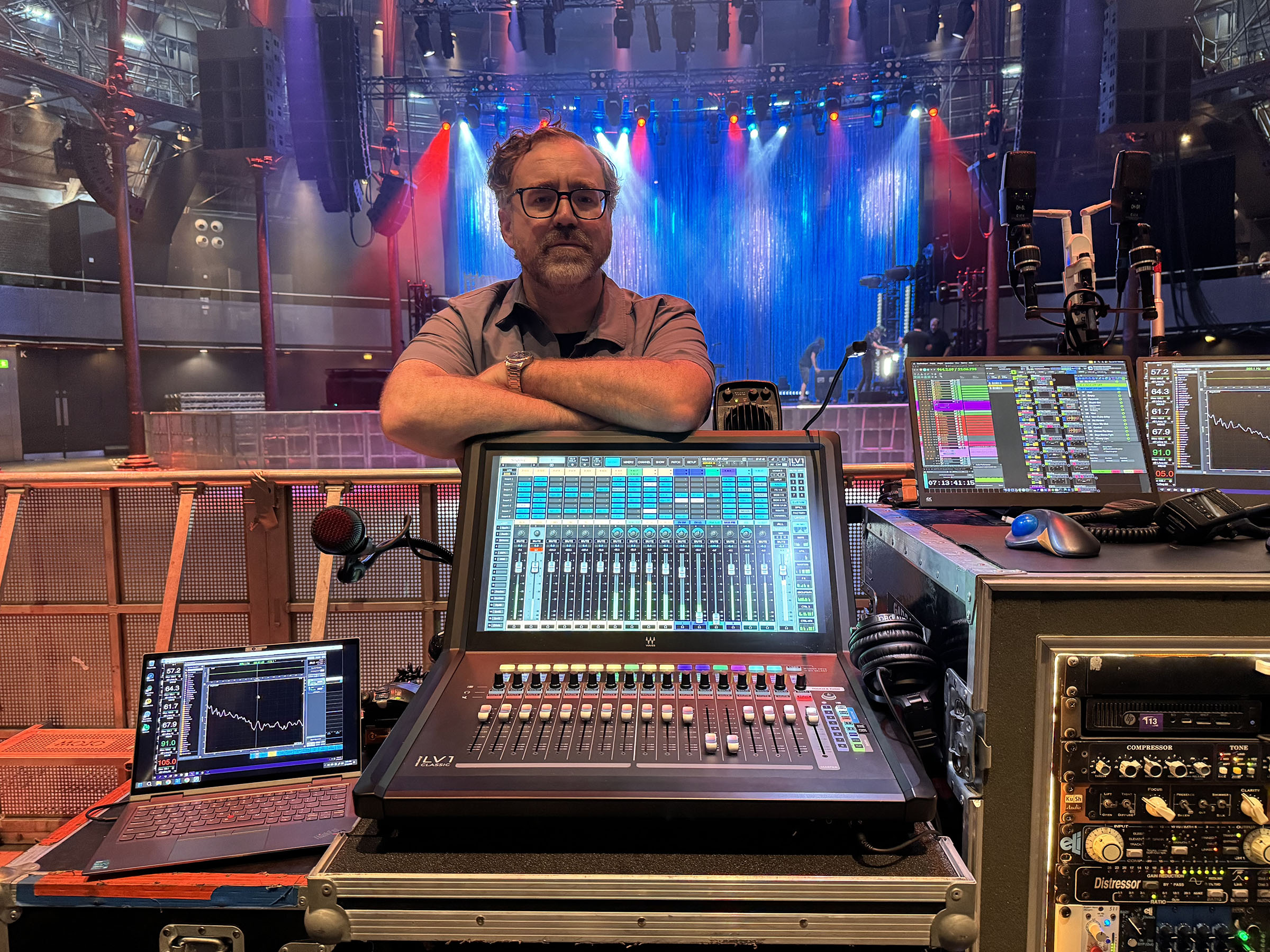
Photo file 1: DavidGaume.JPG
Photo caption 1: FOH engineer David Gaumé, pictured with the Waves LV1 ClassicPhoto file 2: Garbage_FOH.JPG
Photo caption 2: FOH engineer David Gaumé relies on the Waves LV1 Classic for Garbage’s 2026 European tourAbout Waves Audio Ltd.:
Waves is the world’s leading developer of audio DSP solutions for music production, recording, mixing, mastering, sound design, post-production, live sound, broadcast, commercial and consumer electronics audio markets. Since its start in the early ‘90s, Waves has developed a comprehensive line of over 240 audio plugins and numerous hardware devices. For its accomplishments, Waves received a Technical Grammy® Award in 2011; an Engineering, Science & Technology Emmy® Award for its Waves Clarity Vx Pro plugin in 2023; and NAMM Technical Excellence & Creativity (TEC) Awards for its Clarity Vx DeReverb Pro plugin in 2024 and eMotion LV1 Classic console in 2026. Additionally, its early flagship plugin, the Q10 equalizer, was selected as an inductee into the TECnology Hall of Fame.Increasingly leveraging pioneering techniques in artificial intelligence, neural networks and machine learning, as well as the company’s three decades of accumulated expertise in psychoacoustics, Waves technologies are being used to improve sound quality in a growing number of market sectors. Around the world, Waves’ award-winning plugins are utilized in the creation of hit records, major motion pictures, and top-selling video games. Additionally, Waves now offers hardware-plus-software solutions (including the revolutionary eMotion LV1 Classic live mixing console) for professional audio markets. The company’s WavesLive division is a leader in the live sound sector, spearheading the development of solutions for all live platforms. Products from Waves Commercial Audio enable A/V system integrators and installers to deliver superior sound quality for corporate, commercial, government, educational, entertainment, sports and house-of-worship applications. Under its Maxx brand, Waves Software Licensing Division is bringing Waves’ award-winning technology into a variety of consumer-facing markets including Mobile, PC, Home AV, Education and Enterprise. Some of the largest and most prestigious global OEM brands have adopted its DSP algorithms to enhance the sound experiences of their consumers.
North America Offices:
Waves, Inc., 2800 Merchants Drive, Knoxville, TN 37912;
Tel: 865-909-9200, Fax: 865-909-9245, Email: info@waves.com,
Web: http://www.waves.comCorporate Headquarters Israel:
Waves Ltd., Azrieli Center, The Triangle Tower, 32nd Floor, Tel Aviv 67023, Israel;
Tel: 972-3-608-4000, Fax: 972-3-608-4056, Email: info@waves.com,
Web: http://www.waves.comWaves Public Relations:
Clyne Media, Inc., 169-B Belle Forest Circle, Nashville, TN 37221;
Tel: 615-662-1616, Email: robert@clynemedia.com,
Web: http://www.clynemedia.com
All Rights Reserved.